In four runs on Recraft Flash, naming a light changed the picture most: a low, warm sun gave an amber cast and long shadows, though not the direction we asked for. An 85mm f/1.8 line and a low-angle line changed little we could pin on them. Each picture cost 1 credit, and the exact prompts follow.
The test: one still life, four prompts
A still life keeps the comparison honest. A bowl has no face to drift from one run to the next, so what changes between pictures is the words, plus whatever the model decides on its own. All four prompts share one baseline sentence: a bowl of lemons on a worn wooden kitchen table, with a window and a shelf of glass jars behind it. Prompt A is the baseline and a line that keeps text and logos out. B adds a named lens and aperture, C a named light, D an angle and a distance. Each prompt ran once.
We ran them through AIGE's image tool with the model set to Recraft Flash. It reads text only, so it takes no reference photo and no saved character. That is the other reason for a bowl: one face across four shots is a job for a model that takes references, and the model picker article shows which ones do. AIGE also uses a fresh seed on every run, so part of each difference below is chance. You will see it in the bowl.
Baseline: no camera or light words
Prompt A, word for word:
A bowl of lemons on a worn wooden kitchen table, with a window and a shelf of glass jars behind it. No text, labels or logos in frame.
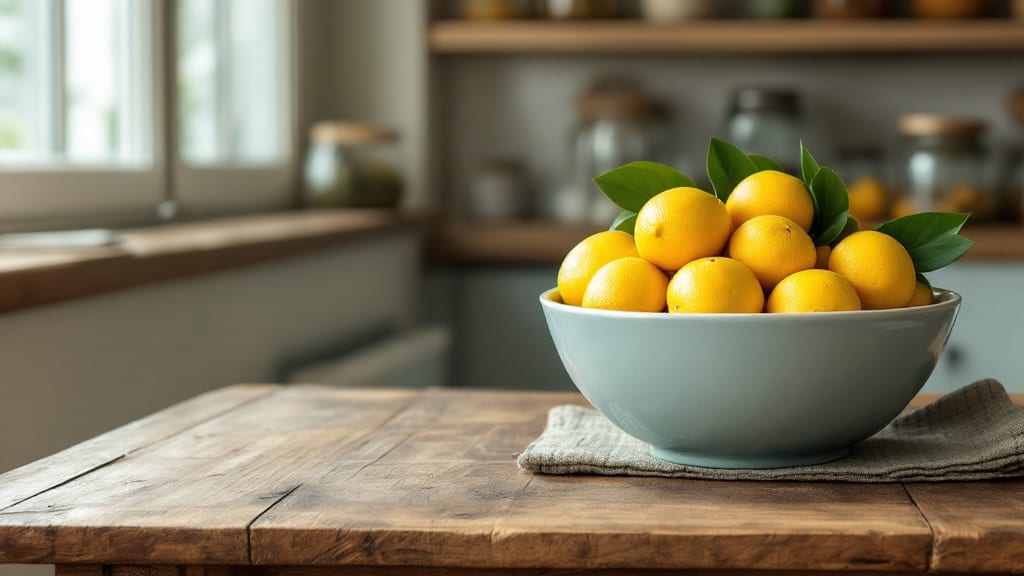
The model filled in everything the prompt left out. It chose a pale blue bowl, a gray linen cloth under it, bright even daylight with no hard shadows, and a camera looking down at the bowl from a little above. The window and the jars are soft: the background is blurred before any lens is named, which matters for the next picture. Keep A in mind as what you get when you leave camera and light out.
Lens and aperture: little we can pin on the words
Prompt B adds one sentence, a camera, a lens and an aperture:
A bowl of lemons on a worn wooden kitchen table, with a window and a shelf of glass jars behind it. Full-frame mirrorless camera, 85mm lens at f/1.8. No text, labels or logos in frame.
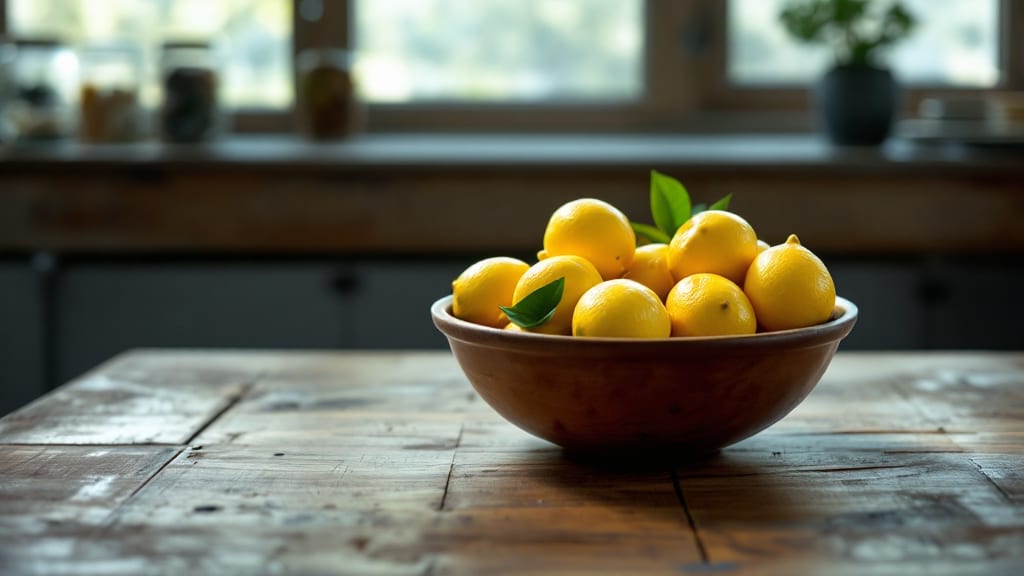
Next to A, the picture is a little darker and moodier. The bowl is terracotta now, the linen cloth is gone, and the window panes across the back have washed out to bright white. The background is soft, but it was soft in A, and picture D below, which has no lens words, is at least as soft behind its bowl. So the 85mm f/1.8 line did not switch blur on. We cannot credit it with the darker look either, because the bowl and the cloth changed without being asked to. A wide aperture is meant to melt the background, and here the model gave that look before it was asked. One test we did not run is f/11 against f/1.8, to see whether the shelf sharpens.
Light: the warmth showed up, the direction did not
Prompt C adds a light in place of a lens: a time of day, a color temperature, a direction and where the shadows fall.
A bowl of lemons on a worn wooden kitchen table, with a window and a shelf of glass jars behind it. Late-afternoon sun, low and warm, about 3500K, raking across the table from camera left, long shadows falling to the right. No text, labels or logos in frame.
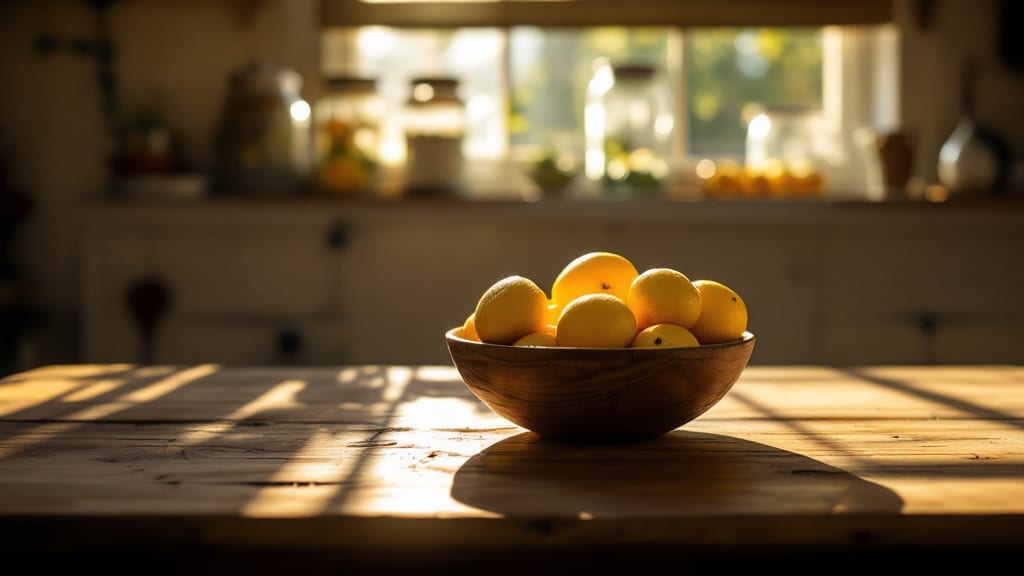
This is the biggest change of the three, and only part of it is what we asked for. The picture turns amber, the table is crossed with stripes of sun and shade, and the bowl throws a long, dark shadow. The sun is coming through the window behind the bowl, so the shadow runs toward the camera and leans to the right. The prompt asked for a sun raking across the table from camera left, with shadows falling sideways to the right, and this reads more like a backlit window than a side light. The window glares, and the front edge of the table falls to near black. The stripes of light were not in the prompt, and neither was the wooden bowl.
So the words for warmth, a low sun and long shadows showed up, and the direction did not follow as written. One picture cannot tell a 3500K sun from a 3000K one, and it cannot say whether another run would light the bowl from the side, so we claim only that warm, low words gave a warm, low light. Light follows a prompt loosely on this model. Of the three slots it still moved the picture most, which is why the prompt template gives light a slot of its own.
Angle and distance: the words that barely showed
Prompt D adds where the camera stands and how far it is from the bowl:
A bowl of lemons on a worn wooden kitchen table, with a window and a shelf of glass jars behind it. Low angle at table height, camera 30 cm from the bowl. No text, labels or logos in frame.
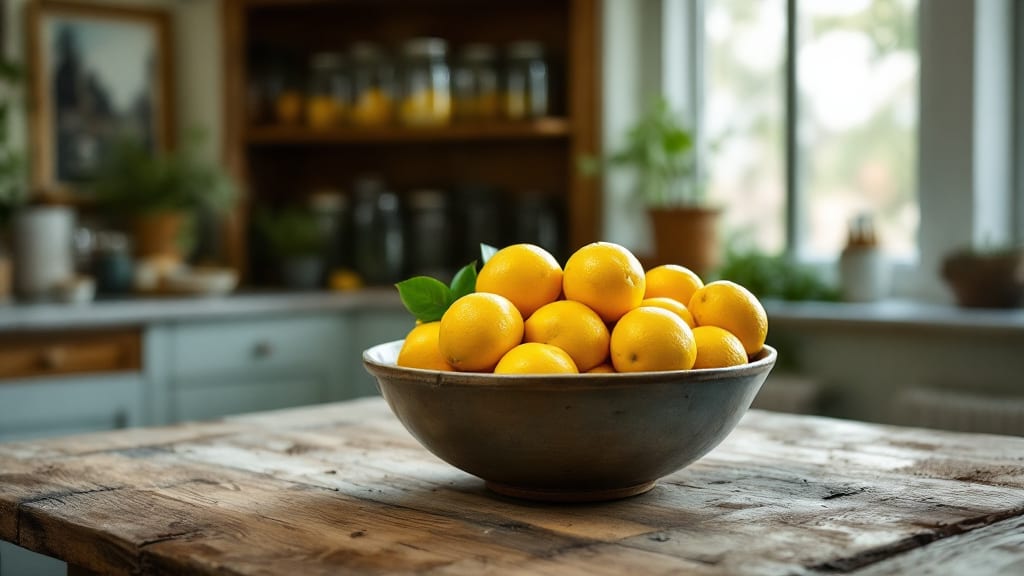
Next to A, the bowl fills the same share of the frame, about two fifths of its width in both, and the camera still looks down at the bowl and the table top. We see no low angle at table height, and nothing shows a move in to 30 centimeters. What changed is the room behind the bowl: a shelf unit full of jars, a framed picture, plants and a window on the right, and the bowl is gray stoneware now. The words reshuffled the scene without moving the camera. If a camera position matters to you, check every frame for it and expect to re-run. A view that is hard to mistake, such as an overhead flat lay, is the one to try first. We did not run it.
What drifted between the four
The bowl is pale blue in A, terracotta in B, wood in C and gray stoneware in D. The linen cloth appears only in A, and leaves show up in A, B and D but not C. The prompt named none of them, so each run chose again. If a bowl has to stay the same across frames, name it in the baseline, something like "a pale blue ceramic bowl", and name the cloth too. That follows from what happened here, and we did not test it. The slot list in the prompt article is the one to check against: any slot you leave empty is a choice the model makes for you.
Where to run these, and what a test costs
Recraft Flash is a tile on the laptop canvas's agent sheet, and the picker article shows where it sits and what every tile costs, while the guides to aspect ratio and image resolution cover the shape and size, which are settings in the picker, not words in the prompt.
Treat Flash as the cheap draft model it is. AIGE's own model guide describes it as fast raster drafts and bulk ideation, and lists photorealism among the jobs to avoid it for. We picked it for the price, so these four pictures are stills made at the lowest cost, not a test of final-quality photoreal work. For an everyday photoreal frame the guide's pick is Nano 2.1, and the Nano Banana prompts page shows ten prompts that were run in AIGE, each beside the image it made. We did not run our four prompts on any other model, so we cannot say whether the lens and light words land better there.
Honest note: Each prompt ran once on one model, so every comparison here sets one picture against another. It is not a measurement, and part of every difference is chance, which the changing bowl shows. In picture C the light words gave the color and the long shadows but not the direction, so light follows a prompt loosely on this model. Every test costs credits: 1 credit a picture here, with an agent turn on top on the laptop canvas, so a four-prompt test like ours is four pictures' worth before you re-run anything. We made the pictures with AIGE's image tool, not on the canvas, so they show what the model does with the words and not what an agent turn does with a message. We asked that tool for 3:2 and got 1024 by 576 pictures, which are 16:9: Recraft takes coarse size presets and the tool maps 3:2 to its wide one. We made no pictures with any other model for this article.
Quick answers
Question | Answer |
|---|---|
What should an AI photoshoot prompt include? | A subject, a setting, a named light, a camera and lens, and an angle. In our four runs the light line changed the picture most, in color and shadow length. The seven-slot template lists all of them. |
Does naming a lens like 85mm f/1.8 change an AI image? | Not in a way we could pin on the words. In one run each, the background was already soft with no lens words, and the picture with no lens words was as soft as the one with them. |
Does naming the light work in an AI photoshoot prompt? | Partly. A low late-afternoon sun gave an amber cast and long shadows. The direction we asked for, from camera left, did not show: the sun came through the window behind the bowl and the shadow ran toward the camera. It was one run of one scene. |
Does an angle like low angle at 30 cm work? | Not visibly. The bowl stayed the same size in the frame and the camera still looked down at it. The room behind the bowl changed instead. |
Can Recraft Flash keep the same subject across prompts? | No. It reads text only, with no reference photo and no saved character, and anything the prompt does not name can change between runs. For one face across a shoot, use a model that takes references, as the picker article shows. |
How much does a Recraft Flash picture cost in AIGE? | 1 credit a picture, and every test costs credits. On the laptop canvas an agent turn, from 2 credits, comes with it. |
Is Recraft Flash good for final photoreal work? | AIGE's own model guide calls it a drafts-and-bulk model and lists photorealism among the jobs to avoid it for. Use it to try a prompt cheaply. We did not test whether a prompt carries over to another model. |
Comments
Be the first to comment.