
To turn a picture into a Kling clip in AIGE, open the Video editor on the laptop canvas, choose From a picture in the Make tab, add a start picture, then pick Kling V3, Kling 3 Turbo or Kling o3 and a length from 3 to 15 seconds. The Make the clip button shows the price first.
Which Kling versions start from a picture
The Model box in the From a picture form lists models from several makers. Three of them are Kling, and they are the ones this guide covers: Kling V3, Kling 3 Turbo and Kling o3. Kling Motion Control is not in the box, because it has no length of its own; it has a separate mode, and Kling Motion Control explained covers it. What Kling AI is covers the versions behind the names and the Pro price table; the prices below are for the Standard tier the editor asks for.
All three make any whole second from 3 to 15, and the length starts at 5. Where they differ is in what the editor sends along with your picture.
Picker label | End picture | What the editor sets | 5 seconds |
|---|---|---|---|
Kling V3 | Yes | Standard tier, sound on | 63 credits |
Kling 3 Turbo | No | Standard tier, no sound setting | 56 credits |
Kling o3 | Yes | Sound on, one price for either tier | 70 credits |
fal, the service AIGE reaches Kling through, describes its o3 image-to-video as taking a start frame and an end frame, with native audio and 3 to 15 seconds. Its page does not compare o3 with V3, so this guide does not say which looks better. Run one picture through both and keep the clip you prefer. fal's page for the Turbo endpoint the editor uses calls it standard, 720p. All three pages were read on 28 October 2026.
The Kling steps in From a picture
These are laptop canvas steps, and the first half is the same for every model: placing a Video widget, opening its editor, choosing From a picture, picking the start picture and the optional Change it first. Turn a photo into a video with AI walks through them. The steps below are the ones where Kling matters.
End on a picture, if you want. Pick a second picture for the clip to arrive at. Use it with Kling V3 or Kling o3 only; the section on ending on a second picture below says why.
Write what happens, or leave it empty. The box is optional. What to ask the picture to do, and how to word it, is in AI animation from one image.
Choose the Kling model and the length. Under Model, pick Kling V3, Kling 3 Turbo or Kling o3, then slide Length to any whole second from 3 to 15. The slider starts at 5.
Read the button, then press it. It says Make the clip, with the price beside it, such as "63 cr". The price shows before you pick a picture, and the button stays off with a short line, "Pick a start picture first.", until you do.
The wait for the clip, the trim and the export are in the same guide.
What the editor decides for you
The form has two controls for the model, Model and Length. It has no switch for sound, none for quality and none for 4K, so the editor fills those in:
Quality. Kling V3 and Kling 3 Turbo are asked for at the Standard tier. Kling o3 goes to its Standard endpoint, and its price is the same at either tier.
Sound. Kling V3 and Kling o3 are asked for with sound on, and the V3 price on the button includes it. fal's V3 page lists its sound setting as on by default. For Kling 3 Turbo, fal's page lists no audio setting and the form sends none, and the price table has no with-sound price for it.
Negative prompt and guidance. A Kling V3 request carries a negative prompt, "blur, distort, and low quality", and a guidance value of 0.5. Both match fal's V3 defaults, and the form has no box for either.
Shape. The clip takes its shape from the start picture. AIGE's code notes that Kling's image-to-video has no aspect-ratio field, and none of the three fal pages lists one. A clip shaped differently from the timeline fills the frame unless you set it to Fit; AI video for YouTube covers shapes and export.
The studio's settings offer more on these models: a 4K switch and a sound switch on Kling V3 and Kling o3, and a Pro or Standard choice on Kling 3 Turbo. This form has none of them. Turbo shows the gap: its Pro tier is 70 credits for 5 seconds in the default table, and this form asks for Standard. If your plan cannot make the default setting, a line under the button says what it changed.
Ending on a second picture
An end picture makes the clip travel from the first picture to the second. Kling V3 and Kling o3 take one: AIGE sends it with the request, and fal's pages for both list an optional end-image field. Adding one does not change the price, because the Kling price code reads the model, the length, the quality and the sound, and no end-picture input.
Kling 3 Turbo does not take one. The request AIGE builds for Turbo carries only the start picture, and fal's Turbo page lists no end-image field. The From a picture form does not hide End on a picture when Turbo is selected, so choose V3 or o3 before you add the second picture. With Turbo selected, a second picture would not be used and the price would not change. The Between two shots mode leaves Turbo out of its list for this reason.
What a Kling clip costs here
The Make the clip button prints the price before you press it, and the table prices the three Kling rows at the settings this form uses. Making a clip needs a plan; pricing lists them.
Length | Kling V3 (Standard, sound on) | Kling 3 Turbo (Standard) | Kling o3 |
|---|---|---|---|
3 seconds | 38 credits | 34 credits | 42 credits |
5 seconds | 63 credits | 56 credits | 70 credits |
10 seconds | 126 credits | 112 credits | 140 credits |
15 seconds | 189 credits | 168 credits | 210 credits |
Here is a worked example with every setting named. The start picture is a product still from your board. Change it first is off, End on a picture is off and the words box is empty. Model is Kling V3 and Length is 5 s. The editor asks for the Standard tier with sound on, so the button reads Make the clip · 63 cr. Slide Length to 10 and it reads 126 cr. Keep the picture and 5 s, switch the model to Kling 3 Turbo and it reads 56 cr; switch it to Kling o3 and it reads 70 cr.
A 3-second take costs 38 credits on Kling V3 and 34 credits on Kling 3 Turbo. That is a cheap check on whether your picture and your motion line work together, and it is not a preview of how a longer clip would play out.
The Kling model page prices a different setting. Its headline is Kling V3 at the Pro tier, 84 credits for 5 seconds with sound and 56 credits without. The editor makes Kling V3 at Standard with sound on, so its button reads 63 cr.
Plan reach matters. In AIGE's default plan table, which can change, Starter makes all three Kling versions at 3, 4 and 5 seconds only, so the 10-second and 15-second rows need Pro, Premier or Max. A length your plan cannot make is tagged with the plan that can, next to the word Length. Live plan settings can differ from the default table, so trust the button. For Kling beside other video models, the AI video for YouTube article prices Kling V3 next to three others, and how long can an AI video be sets the length limits side by side.
Is there a phone version of these steps?
No. These steps are for the laptop canvas. The Video editor, its Make tab and the From a picture form belong to the laptop canvas, and on the phone board a clip opens in a viewer, with no timeline editor.
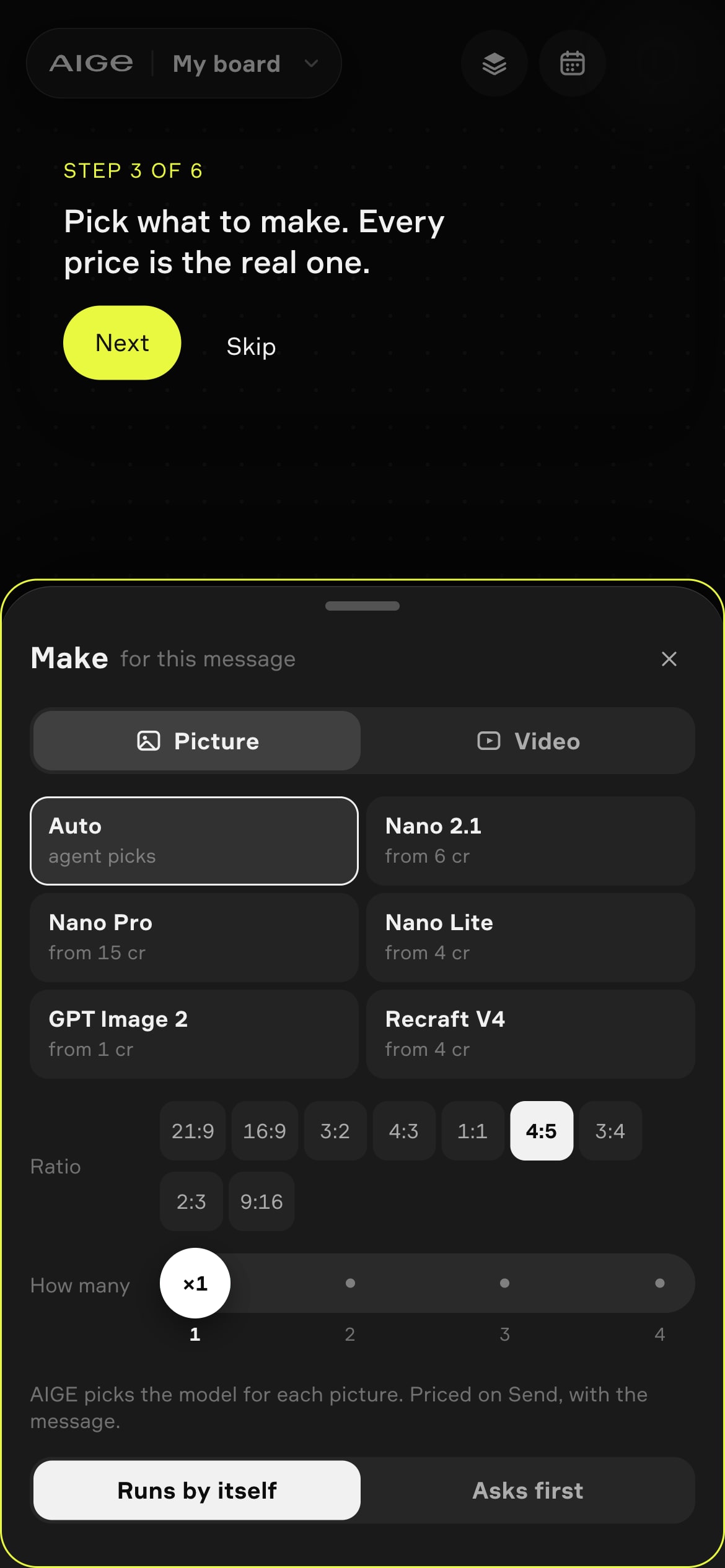
The phone board sits behind a switch that is off by default and is switched on per account, so a signed-in phone without it opens the grid home page. Anyone can open the board's demo at aige.ws/?try=1 on a phone while signed out, but its Send button plays a prepared example and makes nothing, so there is no Kling clip to make there and no phone steps to give. On a phone that does have the board, the Make sheet has a Video tab with a grid of clip models and rows for Length, Sound and Ratio. The AIGE board on your phone walks through it, and AIGE on a phone and on a laptop sets the two surfaces side by side.
Honest note: fal's three model pages were read on 28 October 2026 and vendors change them. This guide shows no clips and compares no results, because we did not run a test set. fal states picture limits (JPG or PNG, up to 50 MB, at least 300 pixels a side, an aspect ratio between 1:2.5 and 2.5:1) on its Turbo page only. Its V3 and o3 pages state none, and the Upload button accepts any image file and checks none of this, so keeping to those limits is the safe course for all three. Prices are AIGE's default credit table, and your plan can change the settings a model runs at.
Quick answers
Question | Answer |
|---|---|
How do I turn an image into a video with Kling in AIGE? | Open the Video editor on the laptop canvas, choose From a picture in the Make tab, add a start picture, pick a Kling version and a length, and press Make the clip. |
Which Kling versions can start from a picture? | Kling V3, Kling 3 Turbo and Kling o3. All three make any whole second from 3 to 15, and only V3 and o3 take an end picture. |
How much does Kling image to video cost in AIGE? | A 5-second Kling V3 clip from a picture costs 63 credits in the editor, at the Standard tier with sound on. Kling 3 Turbo is 56 credits and Kling o3 is 70 credits. The Make the clip button shows the price first. |
Can Kling end on a second picture? | Kling V3 and Kling o3 can. Kling 3 Turbo cannot, and the form does not hide End on a picture for it, so pick V3 or o3 before adding the second picture. |
Does a Kling image-to-video clip have sound? | The editor asks Kling V3 and Kling o3 for sound and has no sound switch. Kling 3 Turbo has no sound setting on fal's page, and the form sends none. |
Can I do Kling image to video on my phone? | This guide covers the laptop canvas. The phone board is switched on per account, and its signed-out demo plays a prepared example and makes nothing. |
Can I use these Kling versions on Starter? | In AIGE's default plan table Starter makes Kling V3, Kling 3 Turbo and Kling o3 at 3, 4 and 5 seconds only. Longer lengths need Pro, Premier or Max. |






Comments
Be the first to comment.